
FDA Food Labeling Requirements: What Food Brands Must Include
This entry was posted on September 15, 2026.
A food label has a lot of work to do. It needs to catch a shopper's attention, identify what's inside the package, and communicate the information consumers need to make an informed purchase. For food brands, that means balancing regulatory requirements with a design that looks good on the shelf and works on the actual container.
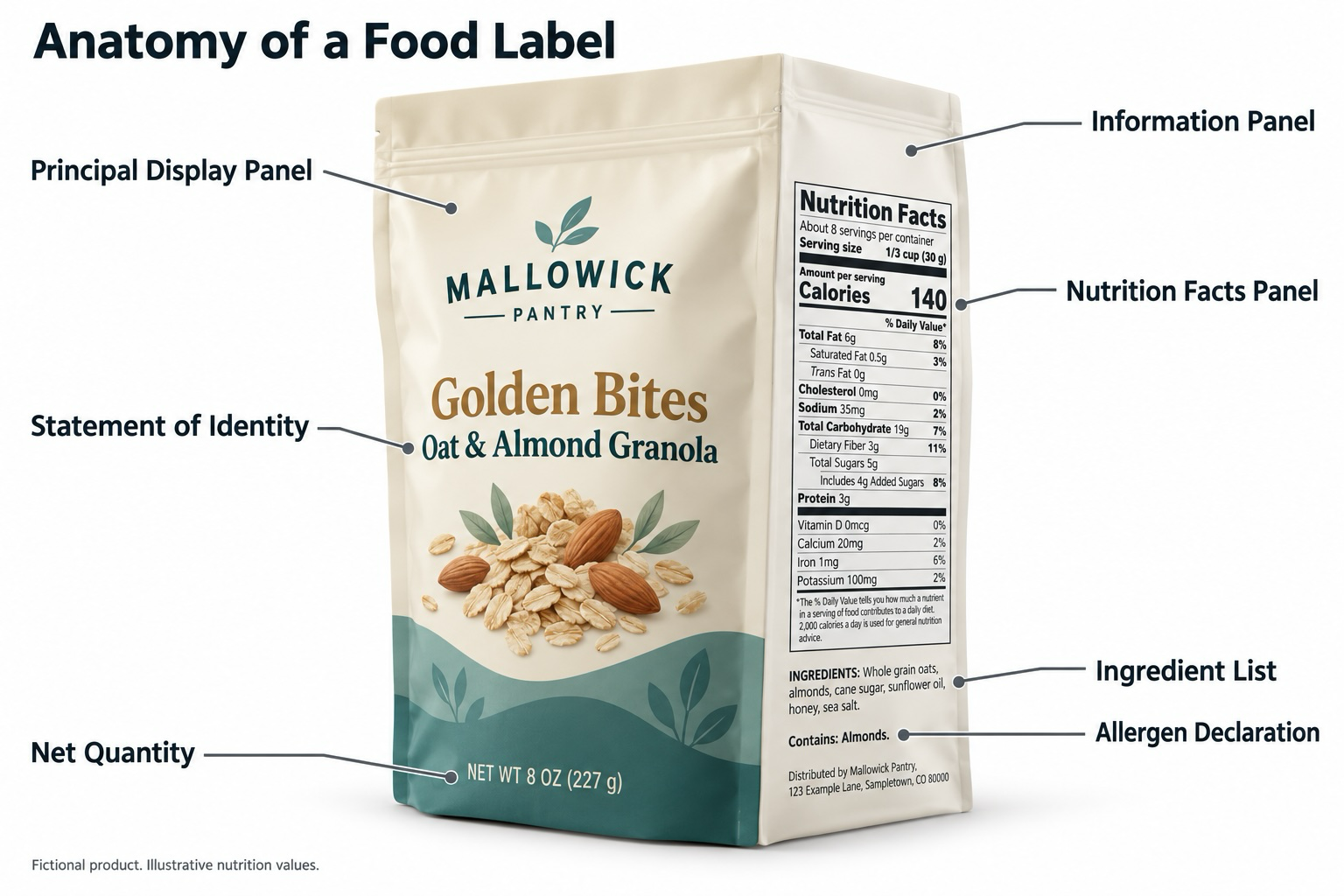
Most FDA-regulated packaged foods need a statement of identity and net quantity on the principal display panel, typically the front of the package. Ingredients, allergen disclosures, business details, and Nutrition Facts generally appear on the information panel. What belongs on your label depends on the product, packaging, claims, and any applicable exemptions.
Understanding these requirements before sending your artwork to print can help you avoid costly revisions, whether you're launching a new product or updating existing packaging.
What Does the FDA Require on a Food Label?
Before getting into the design, it's important to know what information your label needs to accommodate. FDA-regulated packaged foods generally require a statement of identity, net quantity of contents, and the name and place of business. Ingredient lists, major-allergen disclosures, and Nutrition Facts labeling are also required when applicable, unless an exemption applies.
These elements don't all belong in the same place. The table below shows where you'll typically find them, although the final layout depends on the product, package size, claims, and applicable requirements.
Scroll horizontally to view the full table.
| Label element | What it communicates | Typical location |
|---|---|---|
| Statement of identity | The common or usual name of the food | Principal display panel |
| Net quantity of contents | How much product the package contains | Principal display panel |
| Name and place of business | The manufacturer, packer, or distributor responsible for the product | Information panel |
| Ingredient list | Ingredients listed in descending order by weight, when required | Information panel |
| Allergen disclosure | Applicable major food allergens and their food sources | Ingredient area or Contains statement |
| Nutrition Facts | Required nutrition information in the prescribed format | Information panel, unless an exemption applies |
This table is a starting point rather than a complete label specification. Package shape, available label space, and product-specific rules can all affect the final layout. The FDA Food Labeling Guide provides additional detail.
Understanding the Principal Display Panel and Information Panel
Principal Display Panel
Think of the principal display panel as the front of your package, the part shoppers are most likely to see when the product is on the shelf. It generally needs to display the product's statement of identity and net quantity of contents.
The statement of identity tells consumers what the food actually is. Depending on the product, this may be a name established by regulation, a common or usual name, or an appropriately descriptive name. A catchy brand name or flavor description doesn't necessarily satisfy that requirement.
Information Panel
The information panel usually sits immediately to the right of the principal display panel, although placement can vary with the package format.
This is where shoppers will typically find the ingredient list, allergen information, Nutrition Facts, and business name and address. Account for these details early in the design process. Trying to squeeze required information into a finished design can create readability and compliance problems.
FDA Net Weight and Net Quantity Requirements
Net quantity tells shoppers how much food they're getting, not how much the filled package weighs. The container and other packaging materials are excluded from the declaration.
How that amount is expressed depends on the product. A jar of sauce may use weight, while a bottled beverage may use fluid measure. Other foods may be labeled by count or a combination of measurements.
The declaration generally belongs on the principal display panel, with enough separation from surrounding artwork to remain easy to identify. Type size, units, and placement are governed by specific requirements that depend in part on the package dimensions. This is worth accounting for early, particularly when working with small containers or limited label space.
Shipping weight should not be used as a substitute for net contents. The applicable rules are outlined in the FDA net quantity requirements.
Ingredient Lists and FDA Allergen Labeling Requirements
For most multi-ingredient foods, ingredients must appear in descending order by weight, starting with the ingredient used in the greatest amount. Each ingredient generally needs to be identified by its common or usual name.
The list can become more complicated when a product contains compound ingredients, added colors, preservatives, or flavorings. These may have their own naming or disclosure requirements. If you're updating a recipe or changing suppliers, review the ingredient statement before reusing your existing label artwork.
The Nine Major Food Allergens
Federal food-allergen labeling requirements recognize nine major food allergens:
- Milk
- Eggs
- Fish
- Crustacean shellfish
- Tree nuts
- Peanuts
- Wheat
- Soybeans
- Sesame
The food source of each major allergen must be identified as required by federal labeling rules. This may be accomplished through the ingredient name itself, a parenthetical declaration in the ingredient list, or a separate Contains statement immediately after or adjacent to the ingredient list.
Some allergens require more specific identification, including the type of tree nut and the species of fish or crustacean shellfish.
Proprietary recipes do not remove allergen-disclosure obligations. Likewise, voluntary phrases such as “may contain” do not replace required allergen declarations or appropriate manufacturing controls.
The FDA maintains current food-allergen labeling information for businesses preparing allergen statements.
When Is a Nutrition Facts Label Required?
Most packaged foods need a Nutrition Facts label, although certain products and businesses qualify for exemptions. When nutrition labeling is required, the panel must include specific information in the FDA's prescribed format.
A standard Nutrition Facts panel includes:
- Serving size
- Servings per container
- Calories
- Total fat
- Saturated fat
- Trans fat
- Cholesterol
- Sodium
- Total carbohydrate
- Dietary fiber
- Total sugars
- Added sugars
- Protein
- Vitamin D, calcium, iron, and potassium
The information itself is only part of the requirement. The panel's layout, type sizes, and formatting also matter. The FDA provides Nutrition Facts formatting resources to help food brands prepare their artwork.
Small-Business Nutrition Labeling Exemptions
Not every food business needs to include a Nutrition Facts panel on every product. Certain small businesses and low-volume products may qualify for exemptions, but eligibility involves more than simply being a small company. Employee count, sales, units sold, filing requirements, and claims made on the package can all affect whether an exemption applies.
Under one low-volume exemption, a business generally must have fewer than an average of 100 full-time equivalent employees and sell fewer than 100,000 units of the product in the United States during a 12-month period. An annual notice is normally required. A nutrition-labeling exemption does not eliminate other applicable food-labeling requirements.
Other exemptions use different sales tests, and some do not require an annual notice. Certain nutrition or health claims can also make an otherwise exempt product subject to nutrition labeling.
The FDA's small-business nutrition-labeling exemption guidance explains the different pathways in more detail.
Foods With Insignificant Nutrient Amounts
Some foods containing insignificant amounts of nutrients may qualify for simplified nutrition labeling or an exemption under specific conditions. Plain spices, certain flavorings, tea, and coffee are often discussed in this context, but the product category alone does not determine eligibility.
Added ingredients, nutrient content, and package claims can change the analysis, so the exemption needs to match the actual product being sold.
Claims That Can Trigger Additional Labeling Requirements
A product claim can make your packaging more appealing, but it can also change what you're required to include on the label. Terms such as "healthy," "low sodium," and "gluten-free" have regulatory implications that go beyond their everyday meanings.
Before adding a claim to your design, make sure the product meets the applicable criteria and that any required supporting information is included.
“Healthy” Claims
The FDA updated the criteria governing when “healthy” and related terms may be used as implied nutrient-content claims. The final rule considers qualifying food-group content as well as limits for added sugars, saturated fat, and sodium.
The updated definition has a compliance date of February 25, 2028. Brands using or planning to use the term can find transition information in the FDA's current healthy-claim requirements.
Nutrient-Content and Health Claims
Claims such as "low sodium," "reduced sugar," and "good source of fiber" have specific eligibility and presentation requirements. Statements connecting a food or substance with a health condition may also be subject to additional rules.
Even when a claim seems accurate, its use on packaging may depend on qualifying criteria or required disclosures. Confirming those details before finalizing the design is easier than revising printed labels later.
Gluten-Free Claims
Products labeled “gluten-free,” “no gluten,” “free of gluten,” or “without gluten” must meet the FDA standard that applies to those claims.
Organic Claims
Organic labeling is generally administered by the USDA rather than the FDA. Different organic statements and seals can have different formulation, certification, and display requirements.
Plant-Based Product Language
The FDA has issued draft guidance on naming plant-based milk alternatives and using voluntary statements that compare their nutrient content with milk.
Planning a Food Label?
Once you've determined what your label needs to include, it's time to think about how it will fit your packaging. Explore custom food labels in the sizes, shapes, and materials that work for your product.
Which Agency Regulates Your Product?
Before applying FDA labeling requirements to your product, confirm which agency has jurisdiction. Not all foods and beverages follow the same federal labeling rules, and some products may also be subject to state or local requirements.
Scroll horizontally to view the full table.
| Product category | Primary regulatory consideration |
|---|---|
| Most packaged foods | FDA |
| Many meat and poultry products | USDA |
| Certain processed egg products | USDA |
| Many distilled spirits, wines, and malt beverages covered by federal alcohol-labeling laws | Alcohol and Tobacco Tax and Trade Bureau (TTB) |
| Certain alcoholic beverages outside TTB's labeling jurisdiction, including some beers | FDA |
| Cottage foods and locally sold products | State and local requirements may also apply |
The distinction isn't always obvious, particularly with alcoholic beverages. Formulation, alcohol content, and product category can affect which agency's rules apply, so a beverage containing alcohol isn't automatically outside FDA authority.
Current Food Labeling Regulations and Recent Updates
Status checked: September 2026. Not every FDA announcement creates an immediate labeling requirement. Here's where several developments stand and what they may mean for food brands planning new packaging.
Final Rules
The FDA finalized its updated definition of the “healthy” nutrient-content claim in December 2024. The rule became effective on April 28, 2025, and has a compliance date of February 25, 2028.
Proposed Rules
In January 2025, the FDA proposed requiring a Nutrition Info box on the front of most packaged foods that bear a Nutrition Facts label. The proposed box would provide at-a-glance information about saturated fat, sodium, and added sugars.
The front-of-package initiative remains a proposed rule, not a current mandatory label element. Brands developing packaging intended for long-term use may want to follow its progress.
The FDA provides the latest status of the front-of-package nutrition labeling proposal.
Draft or Voluntary Guidance
Draft guidance and voluntary recommendations can inform packaging decisions, but they are not the same as final regulations. The FDA's draft guidance on plant-based milk alternatives is one example.
Common Food Label Compliance Mistakes
A food label can go through several rounds of design and proofing and still contain an overlooked detail. Some problems start with the artwork itself, while others happen when an approved label is reused after a product or ingredient change.
Watch for these common mistakes:
- Leaving a major allergen out of the required declaration
- Using an ingredient list that no longer matches the formulation
- Treating a brand or flavor name as the statement of identity
- Using an incorrect net quantity or placing it improperly
- Printing an unsupported nutrient, health, or free-from claim
- Reusing old artwork after an ingredient or supplier change
- Using outdated regulatory language
- Approving artwork before a qualified reviewer checks the content
- Assuming the label printer is responsible for regulatory approval
A good proofing process starts before the label reaches the printer. Confirm the formulation, have the required information reviewed, and then check the final artwork against the approved content. If an ingredient, supplier, or product claim changes, revisit the label rather than assuming the previous version is still accurate.
Preparing Food Labels for Printing
Once the required information is in place, you still need a label that works on the package. The right dimensions, material, and adhesive depend on the container, how the product is stored, and what the label will encounter during use.
Before sending your artwork to print, consider:
- Final container dimensions
- Label shape and finished size
- Principal display panel and information panel space
- Required copy and applicable type sizes
- Barcode dimensions and quiet zones (the clear spaces required at either end of a barcode)
- Color contrast and legibility
- Refrigerator, freezer, moisture, or oil exposure
- Application surface and temperature
- Expected production quantity
- Whether the formulation or requirements may change soon
A design that looks easy to read on a flat screen may be harder to read once it's wrapped around a small jar or bottle. Account for the container's shape and the space available for required information before finalizing your label dimensions.
Lightning Labels offers several film and paper options, including white, clear, and chrome BOPP, as well as specialty papers such as kraft and Estate 9. Choosing between them involves more than appearance. A refrigerated sauce, for example, may need a different material and adhesive combination than a dry spice jar.
Consider the container surface, application temperature, and potential exposure to moisture or oils. If you're unsure which material is appropriate for your product, discuss its storage and handling conditions with Lightning Labels before ordering.
It's easier to work through design and production details before your file reaches the press. If you're still developing the look of your packaging, explore our food and beverage label design tips or get help from our label graphic design services. Once your design is finalized, review the artwork specifications to make sure your file is set up for production.
Once your label content and artwork are approved, explore custom food labels and custom beverage labels in the sizes, shapes, and materials that fit your packaging.
Ready to Print Your Custom Food Labels?
Have your label content and artwork approved? Get a quote for your custom food labels, or review our artwork specifications before placing your order.
FDA Food Labeling Requirements FAQ
What information is required on an FDA food label?
FDA-regulated packaged foods generally need a statement of identity, net quantity of contents, name and place of business, ingredient list when applicable, major-allergen disclosure when applicable, and Nutrition Facts labeling unless an exemption applies. The exact requirements depend on the product, package, and claims.
Does every packaged food need a Nutrition Facts label?
No. Some foods and businesses qualify for exemptions or simplified labeling. Eligibility may depend on sales, employee count, units sold, nutrient significance, and package claims. Certain nutrient or health claims can also trigger nutrition-labeling requirements.
What are the nine major food allergens?
The nine major food allergens are milk, eggs, fish, crustacean shellfish, tree nuts, peanuts, wheat, soybeans, and sesame. When present, their food sources must be declared according to applicable federal labeling requirements.
Where should net quantity appear on a food package?
The net quantity of contents generally appears on the principal display panel. Units, type size, placement, and separation from other copy depend partly on the package and applicable regulations.
Does the FDA require expiration dates on food labels?
The FDA does not generally require expiration dates on most packaged foods, although infant formula has specific date-labeling requirements. Other federal agencies, state laws, and product-specific regulations may impose additional requirements.
Can a small food business qualify for a nutrition-labeling exemption?
Yes. Some small businesses and low-volume products may qualify. Employee count, units sold, annual sales, claims, and filing requirements can all affect eligibility.
Does FDA or TTB regulate alcoholic beverage labels?
It depends on the product. TTB oversees labeling for many distilled spirits, wines, and malt beverages, while the FDA regulates certain alcoholic beverages outside TTB's labeling jurisdiction, including some beers. Formulation, product category, and alcohol content can affect which requirements apply.
Related Products
-
 Custom Labels
-
Bath & Body Product Labels
-
Custom Candle Labels
-
E-Juice Vape Labels
-
Variable Label Printing
-
Health & Nutraceutical Product Labels
-
Custom Beverage Labels
-
Custom Bottle Labels
-
Custom Lip Balm Labels
-
Home & Garden Product Labels
-
Custom Warning & Safety Labels
-
Perfume Bottle Labels
-
Bumper Stickers
-
Custom Prop 65 Warning Labels
-
Extended Content Labels
-
Custom CBD Labels
-
Barcode Labels
-
QR Code Labels
-
Honey Jar Labels
-
Tea Labels
-
Custom Pet Product Labels
-
Custom Hemp Labels
-
Canning Labels
-
Custom Hand Sanitizer Labels
-
Custom Beer Labels
-
Sustainable Hemp Label Material
-
Blank Labels
-
Embossed Labels
-
Custom Hot Stamp Labels
-
Custom Stickers
 Custom Labels
  Bath & Body Product Labels
  Custom Candle Labels
  E-Juice Vape Labels
  Health & Nutraceutical Product Labels
  Custom Beverage Labels
  Custom Bottle Labels
  Custom Lip Balm Labels
  Home & Garden Product Labels
  Custom Warning & Safety Labels
  Perfume Bottle Labels
  Bumper Stickers
  Custom Prop 65 Warning Labels
  Custom Stickers